Baimaoxing
In 2026, global buyers will examine Angle Steel more carefully than ever. Infrastructure schedules are tightening. Material costs remain unpredictable. Sustainability claims also require stronger evidence.
Dr. Edwin Basson, Director General of the World Steel Association, has stated, “Steel is essential to our modern way of life.” His observation explains why angle profiles remain important. They support warehouse frames, solar structures, bridges, towers, and industrial platforms.
This guide examines the top Angle Steel types expected to attract international demand. Equal-leg hot-rolled angles will remain popular for balanced loading and straightforward fabrication. Unequal angles may offer better strength distribution where space is limited. Galvanized angles will suit outdoor projects, especially when moisture and maintenance create practical concerns. Stainless steel angles will serve corrosive environments, including food-processing areas and coastal facilities. High-strength low-alloy grades may help reduce structural weight, although their higher price needs careful evaluation.
Specifications matter more than attractive product photos. Buyers should compare grade, thickness, leg dimensions, length tolerance, surface condition, and mill test certificates. ASTM A36, ASTM A572, and EN 10025 grades may appear similar, but they are not automatically interchangeable. Independent inspection can reveal lamination, uneven edges, or coating defects before shipment.
There is no universal “best” type. That is the uncomfortable part. A cheaper angle may create higher cutting, coating, or maintenance costs later. This article compares performance, availability, corrosion resistance, certification, and total project value. Some recommendations may need revision as steelmaking technology and regional supply conditions change.
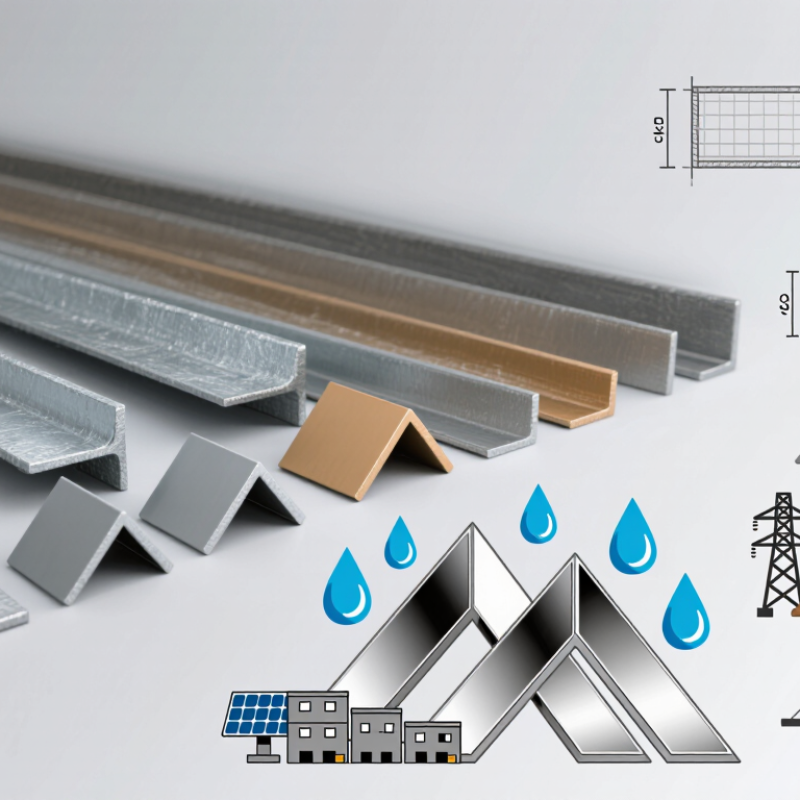
Angle steel is a rolled structural section with two legs meeting at a right angle. It supports frames, bracing, platforms, towers, and machinery bases. Equal angle steel has legs of the same width, making load distribution predictable. Unequal angle steel offers a wider bearing surface on one side. That small difference matters when designers face limited space or uneven forces.
Carbon steel angles remain common for warehouses, bridges, equipment supports, and general fabrication.
Galvanized angles add zinc protection for outdoor structures, coastal sites, and humid storage areas.
Stainless steel angles suit food-processing rooms, chemical environments, and architectural details where corrosion resistance matters.
High-strength grades can reduce weight, but they may require stricter welding and forming controls. Stronger is not always better.
Global buyers should compare dimensions, thickness, steel grade, surface condition, and manufacturing tolerances. Project specifications may follow different regional standards, so equivalent grades need careful verification. Request mill certificates, mechanical test results, coating thickness records, and dimensional inspection reports. Check the heel radius too. It affects fit-up and connection details.
A neat spreadsheet can still hide mismatched assumptions. Field inspections often find small twists, rough edges, or inconsistent galvanizing that paperwork misses. Delivery planning also matters because long angles can bend during handling. Clear packing requirements protect usable material from the port to the construction site.
In 2026, global buyers can choose from several angle steel types, each suited to different project demands. Equal angle steel has two matching legs and supports frames, shelves, towers, and general fabrication. Unequal angle steel offers different leg lengths, helping engineers manage uneven loads or restricted installation space. It depends.
Carbon steel angles remain popular because they combine strength, availability, and practical pricing. Common structural grades include ASTM A36 and higher-strength options such as A572, while buyers using European specifications may request EN 10025 grades.
Hot-rolled angles usually provide dependable structural performance, but surface scale may require cleaning before painting. Galvanized angle steel adds zinc protection for outdoor platforms, agricultural buildings, and damp storage areas. Stainless steel angles suit food-processing rooms, coastal equipment, and applications needing stronger corrosion resistance.
The cost difference is significant.
Experienced buyers should confirm leg dimensions, thickness, length tolerance, steel grade, and coating weight before ordering. A 50 × 50 × 5 mm equal angle does not perform like a 75 × 50 × 6 mm unequal angle, even when both look similar in a catalog. Request mill certificates, dimensional inspection reports, and clear packing details.
Check the loading plan too. I would not select galvanized steel solely because the project is outdoors; trapped moisture and cut edges can still create weak points.
Specifications sometimes appear complete, yet drainage, welding compatibility, or local availability receives too little attention.
What Are 2026 Top Angle Steel Types for Global Buyers?
Global buyers usually compare equal-leg, unequal-leg, galvanized, stainless, and carbon steel angles. Equal angles suit frames and bracing because both legs share loads evenly. Unequal angles help when one connection surface needs more width. Carbon grades such as S235, S275, S355, A36, and A572 may appear in quotations. However, these grades are not automatically interchangeable. Confirm the applicable standard, yield strength, chemistry, and impact requirements.
Size comparison needs more than leg length. Check both leg dimensions, thickness, corner radius, unit weight, and allowable tolerance. A 50 × 50 × 5 mm angle behaves differently from a 50 × 40 × 5 mm angle. Hot-rolled sections generally offer consistent geometry. Bent sections can fit special designs, but springback may affect accuracy. Request dimensional inspection data. Small deviations can complicate bolted connections.
Surface finish should match the service environment. Black mill scale is economical for indoor fabrication, but it needs proper preparation before painting. Pickled and oiled angles offer a cleaner base. Hot-dip galvanized angles provide stronger protection in humid or outdoor conditions. Stainless steel works well in corrosive areas, though its higher cost needs justification. Ask for heat numbers, mill test certificates, coating thickness, and packing details. Do not trust a familiar grade name alone. That shortcut sometimes fails. A practical comparison should include availability, cutting loss, welding needs, and delivered weight.
Indicative minimum yield strength comparison for widely specified structural angle steel grades.
A36 and SS400 are common general-purpose grades. S275JR, S355JR, and A572 Grade 50 provide higher specified yield strength, subject to thickness and applicable standard requirements.
Equal angles have matching legs, while unequal angles have different leg lengths. Buyers should verify leg dimensions, thickness, length tolerance, section mass, and local design tables.
Black hot-rolled, pickled and oiled, painted, and hot-dip galvanized finishes are common. Surface treatment primarily affects corrosion resistance, not the specified base-steel yield strength.
Values shown are nominal minimum yield-strength references in MPa. Actual requirements can vary with product thickness, governing standard, delivery condition, and certification.
What Are 2026 Top Angle Steel Types for Global Buyers?
Selecting Angle Steel for Different Industrial Applications
Angle steel selection starts with the load, not the catalogue photograph. Equal angles suit balanced frames, bracing, towers, and machinery guards. Unequal angles place more steel where bending demand is higher. That difference matters in compact supports and offset connections. World Steel Association data recorded 1.839 billion tonnes of crude steel production in 2024. Its 2024 Short Range Outlook projected global steel demand growth of 1.2% in 2025.
For structural frames, specify yield strength, section thickness, and connection design together. Carbon steel angles often serve building supports and fabrication work. Galvanized angles are more practical around moisture, road dust, and outdoor equipment. For welded assemblies, confirm weldability and impact requirements before ordering. ASTM A36 and EN 10025 grades are common references, but equivalent grades require careful verification. OECD’s Steel Outlook 2024 warns that capacity growth may outpace demand in several regions. Price alone can become misleading.
Tips: Request mill certificates, heat numbers, dimensional tolerances, and coating thickness. Check whether the supplier reports actual test results or only nominal values. A drawing may list one grade while the site demands another. That mismatch is easy to miss. I have seen practical decisions change after corrosion exposure, bolt clearance, or transport limits were reviewed. The neatest specification is not always the safest one.
What Are 2026 Top Angle Steel Types for Global Buyers?
In 2026, global buyers will commonly compare equal angle, unequal angle, galvanized angle, and stainless angle steel. Equal angles suit frames, supports, and general fabrication. Unequal angles help when one side needs greater load distribution. Galvanized angles perform better in humid yards and outdoor structures. Stainless grades serve corrosive locations, but their purchase price is much higher.
Standards must match the project and destination market. Buyers often review ASTM, EN, or JIS requirements before requesting quotations. Check grade, chemical composition, yield strength, dimensions, and permitted tolerances. A mill test certificate should identify the heat number and inspection results. Ask for coating thickness records when buying galvanized products. Paperwork alone is not enough. Samples and independent inspection can expose uneven edges, surface cracks, or inaccurate leg sizes.
Supply reliability affects the real cost. Compare production lead time, minimum order quantity, packing, port handling, and inland delivery. A low unit price may hide expensive delays. Cheap steel can become expensive. Request several quotations using identical specifications and Incoterms. Then compare landed cost, not only the factory price. Quality control should include pre-shipment dimensional checks, bundle markings, corrosion protection, and photograph records. Some buyers overlook packaging until rust appears after a long sea journey. That mistake deserves reflection. A stronger purchasing plan leaves room for weather delays, inspection disputes, and changing freight rates.
Comparative procurement table for commonly traded equal and unequal structural angle steels. Mechanical values are minimum or standard-design values where specified; final acceptance should follow the applicable standard, ordered thickness, heat-treatment condition, and inspection documents.
| Angle Steel Type | Typical Standard | Common Grade | Typical Yield Strength | Typical Tensile Strength | Typical Global Applications | Supply Considerations | Relative Cost | Recommended Quality-Control Checks |
|---|---|---|---|---|---|---|---|---|
| Carbon Equal Angle | ASTM A36 / A6 | A36 | ≥ 250 MPa | 400–550 MPa | General fabrication, frames, platforms, brackets, supports, and non-specialized structural work. | Very broad availability in standard sizes and commercial lengths; normally suitable for routine project schedules. | Low | Verify heat number, chemical composition, tensile and yield results, dimensional tolerances, straightness, and mill test certificate traceability. |
| High-Strength Carbon Equal Angle | ASTM A572 / A6 | Grade 50 | ≥ 345 MPa | ≥ 450 MPa | Load-bearing frames, towers, bridges, heavy equipment supports, and weight-sensitive structures. | Common internationally, but very large sections, unusual thicknesses, and special lengths may require advance planning. | Medium | Check grade identification, heat analysis, mechanical test results, weldability requirements, thickness range, and impact-test requirements when specified. |
| European Structural Equal Angle | EN 10025-2 | S275JR | ≥ 275 MPa ≤ 16 mm thickness |
410–560 MPa | General structural steelwork, industrial buildings, platforms, stair structures, and fabricated assemblies. | Strong availability across markets using European dimensions; confirm EN section tolerances and CE-related documentation where applicable. | Low to Medium | Confirm inspection document type, product analysis, yield and tensile results, impact classification, dimensions, mass, and marking. |
| European High-Strength Equal Angle | EN 10025-2 | S355JR | ≥ 355 MPa ≤ 16 mm thickness |
470–630 MPa | Heavy structural frames, cranes, bridges, transmission structures, and applications requiring higher load efficiency. | Widely traded, although heavy sections and non-stock thicknesses can have longer rolling or allocation lead times. | Medium | Verify thickness-dependent yield values, Charpy impact classification, weldability data, dimensional tolerances, and full heat traceability. |
| Japanese Industrial Carbon Angle | JIS G 3101 | SS400 | Typically ≥ 245 MPa ≤ 16 mm thickness |
400–510 MPa | Fabrication, machinery bases, general construction, brackets, and structural components in Asian supply chains. | Good regional availability; section dimensions may differ from EN or ASTM sizes, so nesting and connection details must be checked. | Low | Check JIS compliance, thickness-dependent yield requirement, chemical limits, tensile results, section dimensions, and certificate authenticity. |
| Chinese Carbon Equal Angle | GB/T 700 | Q235B | ≥ 235 MPa | 370–500 MPa | General construction, fabricated supports, machinery, storage systems, and standard steel structures. | Extensive size coverage and competitive supply; confirm whether the selected size is hot-rolled and whether export documentation matches the purchase specification. | Low | Review chemical composition, yield and tensile data, bend test where required, surface condition, dimensions, marking, and third-party inspection scope. |
| Chinese High-Strength Equal Angle | GB/T 1591 | Q355B | ≥ 355 MPa | 470–630 MPa | Heavy structures, towers, bridges, industrial frames, and projects seeking a higher strength-to-weight ratio. | Broad production capacity; confirm the exact subgrade, thickness range, impact requirement, and compatibility with the project design code. | Medium | Check heat and product analysis, mechanical properties by thickness, Charpy impact results when required, weldability, and dimensional inspection. |
| Austenitic Stainless Equal Angle | EN 10088-3 / ASTM A276 or equivalent | 304 / 1.4301 | Typically ≥ 205 MPa 0.2% proof stress |
Typically ≥ 515 MPa | Food equipment, architectural trim, chemical-service structures, clean environments, and general corrosion-resistant fabrication. | Usually available in common sizes, but surface finish, non-standard thickness, and small quantities can increase lead time. | High | Verify alloy chemistry, corrosion-grade designation, surface finish, PMI or alloy identification, dimensional tolerance, passivation requirements, and certificate traceability. |
| Austenitic Stainless Equal Angle | EN 10088-3 / ASTM A276 or equivalent | 316 / 1.4401 | Typically ≥ 220 MPa 0.2% proof stress |
Typically ≥ 515 MPa | Marine atmospheres, chloride-exposed equipment, wastewater facilities, chemical processing, and coastal construction. | Supply is established but price and availability are sensitive to nickel and molybdenum alloying costs; confirm stock before ordering. | High | Confirm molybdenum-containing chemistry, PMI results, surface condition, intergranular-corrosion requirements where specified, and segregation from carbon steel. |
| Unequal Structural Angle | EN 10025, ASTM A36/A572, JIS or GB equivalents | Project-specific grade | Depends on selected grade | Depends on selected grade | Bracing, trusses, lattice structures, vehicle frames, towers, and designs requiring directional stiffness. | Less universally stocked than equal angles; confirm leg lengths, thickness, rolling availability, cutting plan, and minimum order quantity. | Medium | Approve the exact dimensional standard, inspect both leg dimensions, verify section mass, check twist and straightness, and confirm grade-specific test data. |
Equal-leg angles have matching dimensions, such as 50 × 50 × 5 mm. They distribute loads evenly in frames, supports, and bracing. Unequal-leg angles provide a wider connection surface. Check both legs, thickness, corner radius, and unit weight. Do not compare leg length alone.
No. Confirm the required standard, yield strength, chemical composition, and impact properties. A familiar grade name can create false confidence. The quotation should match the project specification exactly. That shortcut sometimes fails.
Check both leg dimensions and the material thickness. Also review corner radius, unit weight, and permitted tolerances. A 50 × 50 × 5 mm angle differs from a 50 × 40 × 5 mm angle. Small size variations can complicate bolted connections. Request dimensional inspection records.
Hot-rolled angles usually provide consistent geometry. Bent sections can suit special shapes and smaller production needs. However, springback may affect their final accuracy. Confirm measured dimensions after forming. The drawing is not enough.
Black mill scale is economical for indoor fabrication. It needs proper cleaning before painting. Pickled and oiled surfaces provide a cleaner coating base. Hot-dip galvanized angles offer stronger protection outdoors. Stainless steel suits more corrosive environments, but costs more.
Request heat numbers and mill test certificates. Check grade, chemistry, yield strength, dimensions, and inspection results. For galvanized angles, request coating thickness records. Ask for bundle markings and packing details. Paperwork alone is insufficient.
Compare several quotations using identical specifications and delivery terms. Include production time, minimum order quantity, packing, port handling, and inland delivery. Calculate landed cost instead of comparing factory prices only. A low unit price may hide costly delays. Freight rates can change.
Inspect leg sizes, thickness, straightness, edges, and visible surface cracks. Check bundle markings against the order documents. Review corrosion protection and photograph each packed bundle. Samples or independent inspection can reveal uneven edges. Packaging matters. Rust may appear after a long sea journey.
In 2026, Angle Steel remains a fundamental structural material for global construction, infrastructure, manufacturing, and engineering projects. Buyers can choose from equal-leg, unequal-leg, hot-rolled, galvanized, and stainless steel angles, depending on the required strength, corrosion resistance, weight, and fabrication needs. Understanding each type helps purchasers select suitable products for frames, supports, towers, bridges, machinery, warehouses, and general structural assemblies.
A reliable buying decision should compare steel grades, dimensions, leg shapes, thicknesses, tolerances, and surface finishes rather than focusing only on price. Application conditions, including load requirements, exposure to moisture, temperature changes, and welding or cutting processes, also influence the best selection. Global buyers should verify applicable standards, mill documentation, inspection procedures, packaging, delivery capacity, and quality consistency. By balancing technical performance, supply stability, total cost, and quality control, purchasers can secure Angle Steel that meets project specifications and supports safe, durable, and efficient construction.
